An Educational Guide for Commercial Property Owners in the Piedmont Triad
This guide focuses on exposed-fastener commercial metal roofing systems, including corrugated and trapezoidal (R-panel) roofing commonly found on warehouses, manufacturing facilities, and other commercial buildings throughout North Carolina's Piedmont Triad.
A commercial metal roof can remain in service for decades, but eventually, even a well-installed roofing system begins showing signs of age. Rust develops around fasteners, seams begin leaking, protective finishes deteriorate, and building owners face an important decision:
Should the existing metal roof be coated, repaired, retrofitted, or replaced?
Roof coatings can be an effective way to extend the service life of an aging commercial metal roof. However, not every metal roof is a suitable candidate for restoration.
The difference often comes down to something a coating cannot fix: the condition of the metal roof assembly beneath it.
Understanding what makes a metal roof unsuitable for coating can help commercial property owners avoid investing in a restoration system that may not address the actual problem.
A Roof Coating Is Not a Structural Repair
Commercial metal roof coatings are fluid-applied systems designed to protect and waterproof an existing roof surface.
When properly specified and installed over a suitable substrate, a coating system can help protect against weathering, seal properly prepared seams and fasteners, and extend the roof's useful life without a complete tear-off.
But a coating cannot restore metal that has rusted through, correct failed structural attachments, or repair deteriorated supporting members.
That evaluation goes well beyond checking for visible leaks.
1. When Corrosion Has Progressed Beyond Surface Rust
Rust is one of the most common concerns with aging commercial metal roofs, particularly around fasteners, panel laps, penetrations, and areas where moisture repeatedly collects.
However, not all corrosion requires replacement.
Light surface oxidation may be addressed through appropriate cleaning, surface preparation, corrosion-resistant primers, and a compatible restoration system.
The concern becomes more serious when corrosion has compromised the metal itself.
Warning signs include:
- Deep pitting or significant metal loss.
- Rust-through holes or perforated panels.
- Severe corrosion along panel laps and fastener locations.
- Deterioration around eaves, gutters, and other moisture-prone areas.
- Corrosion affecting structural purlins or supporting members.
A coating cannot restore the original thickness or strength of deteriorated steel.
When corrosion is localized, replacing damaged panels may allow the remaining roof to be repaired or restored.
When deterioration is widespread, a metal roof retrofit or replacement may provide a more reliable long-term solution.
The deciding factor is not simply whether rust is visible, but whether the underlying metal remains serviceable.
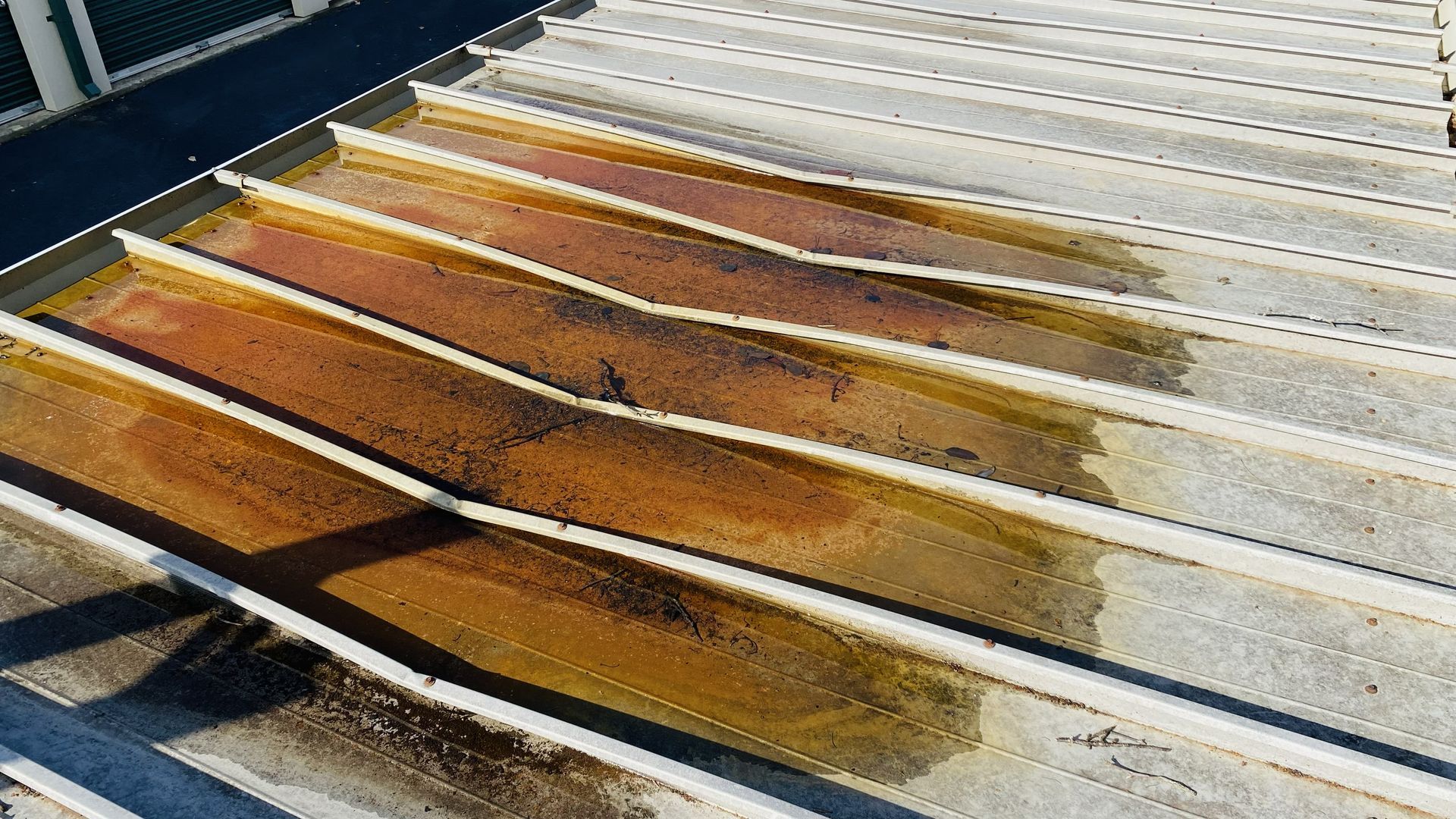
Extensive corrosion across commercial metal roof panels. An inspection is necessary to determine whether the deterioration is limited to the surface or has compromised the metal.
2. When Fasteners Can No Longer Secure the Roof Properly
Exposed-fastener metal roofing systems rely on mechanical attachments to secure panels to the supporting structure.
Over time, temperature changes, building movement, and weather exposure can contribute to loose fasteners, deteriorated sealing washers, and enlarged fastener holes.
Some of these problems can be corrected during a properly designed restoration project.
For example, isolated loose or deteriorated fasteners may be replaced, and suitable fastener locations can be sealed as part of the coating system.
But widespread attachment problems require closer attention.
If fasteners repeatedly back out, no longer engage the supporting members, or have damaged the surrounding metal, applying a coating over the fastener heads does not restore their holding strength.
This distinction matters because a watertight fastener is not necessarily a structurally secure fastener.
When attachment failure is extensive, the contractor must determine whether the existing panels can be properly secured or whether a different roofing solution is necessary.
3. When Panel Seams and Thermal Movement Are Causing Repeated Failures
Commercial metal roofs expand and contract as temperatures change.
That movement is a normal part of metal roofing performance, but it also places repeated stress on seams, end laps, fasteners, and penetrations.
Over time, movement can contribute to:
- Separated or deteriorated panel laps.
- Failed seam sealants.
- Enlarged fastener holes.
- Distorted or displaced panels.
- Recurring leaks at the same locations.
A properly designed restoration system may accommodate normal movement when the underlying roof remains sound and the seams are adequately repaired and reinforced.
However, if panel movement exceeds what the proposed restoration system can accommodate, or seams have suffered substantial mechanical failure, the underlying problems must be corrected before coating.
4. When Existing Roof Assemblies Conceal Additional Problems
One of the most important parts of evaluating an older commercial metal roof is understanding what has already been installed.
Not every metal roof consists of a single exposed layer of roofing panels.
Some buildings have undergone previous repairs, coatings, foam applications, or roof recover projects. These modifications can make it more difficult to determine the condition of the original roof assembly.
Existing coatings may also be peeling, blistering, or separating from the underlying surface.
What If the Metal Roof Already Has an Aluminum Coating?
Many older commercial metal roofs have received aluminum coatings during previous maintenance or restoration projects.
Although some acrylic and silicone restoration systems may be compatible with existing aluminum coatings, applying a new coating without evaluating the underlying surface can lead to adhesion failure.
Aluminum coatings that are chalking, peeling, flaking, or poorly bonded may not provide a suitable substrate for another restoration system.
Before proceeding, the roofing contractor should evaluate the existing coating's condition, perform adhesion testing, and verify the proposed coating manufacturer's requirements for surface preparation and compatible primers.
If the existing aluminum coating cannot provide a sound, properly prepared substrate, removal of deteriorated material or an alternative roofing solution may be necessary.
A new coating system is only as reliable as the surface beneath it.
What Should Be Evaluated Before Restoration?
Before recommending restoration, a roofing contractor should establish:
- What roofing materials and previous restoration systems are present.
- Whether existing coatings and roofing materials remain securely bonded or attached.
- Whether the proposed coating is compatible with the existing surface.
- Whether adhesion testing, specialized preparation, or primers are required.
- Whether moisture or deterioration is concealed within the assembly.
- Whether the proposed work meets applicable building code and manufacturer requirements.
The visible roof surface does not always tell the entire story.
A restoration proposal should account for the condition and history of the existing roof—not simply the appearance of its top layer.
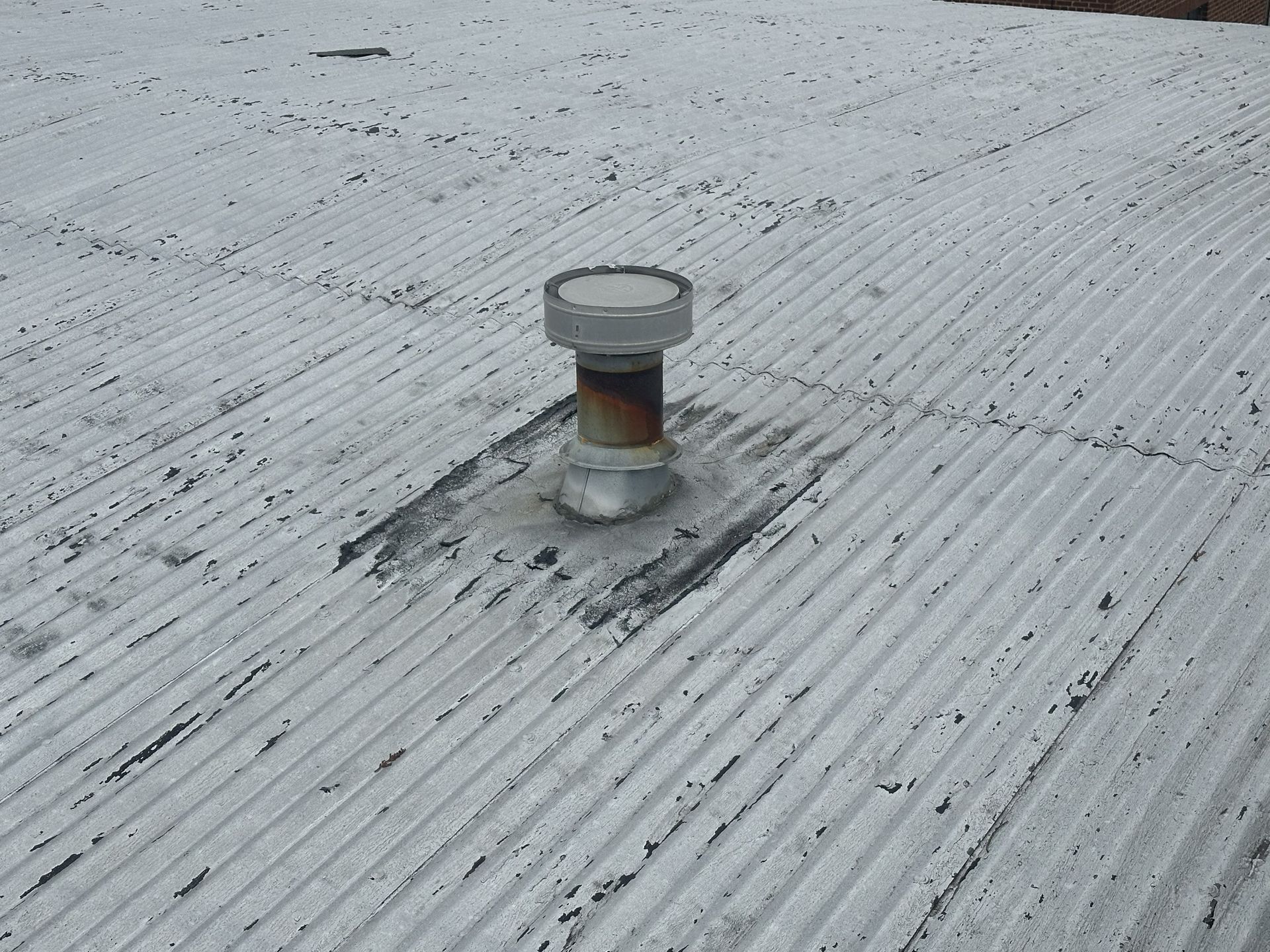
An aging commercial metal roof showing a weathered surface coating and previous repairs around a roof penetration.
5. When Hidden Moisture Has Damaged the Roof Assembly
Water intrusion is not always obvious from the exterior of a commercial metal roof.
Leaks around penetrations, panel laps, fasteners, or flashing details can allow moisture to enter concealed areas of the roof assembly.
Depending on the roof's construction, moisture may affect insulation, interior components, or the underside of the metal panels.
In some buildings, condensation can also contribute to moisture-related deterioration.
A coating applied to the exterior surface will not remove moisture already trapped within the roof assembly.
If insulation is wet or supporting components have deteriorated, those conditions must be investigated and addressed before a restoration system is installed.
Localized moisture damage may be repairable, but extensive deterioration can make restoration impractical. The deciding factor is whether the affected roof assembly can be returned to a sound, serviceable condition before coating.
6. When Structural Deterioration Makes Restoration Unsafe or Impractical
Metal roof panels depend on the supporting structure beneath them.
Purlins, framing, and other structural components must remain capable of supporting the existing roof and any proposed roofing work.
Warning signs that warrant further evaluation include:
- Corroded or deteriorated purlins.
- Sagging or visibly deflected roof areas.
- Compromised panel attachment locations.
- Structural damage associated with prolonged water intrusion.
- Concerns about the roof's ability to support additional loads.
A roof coating does not strengthen deteriorated framing or restore lost structural capacity.
Where structural concerns are identified, additional evaluation by a qualified structural professional may be necessary before deciding whether the roof can be repaired, retrofitted, or replaced.
Even a metal-over-metal retrofit requires an adequate supporting structure and a properly designed attachment system.
Installing a new roofing system over an existing roof does not eliminate the need to evaluate what is underneath it.
When Is a Metal Roof Retrofit a Better Alternative?
Sometimes a commercial metal roof has reached the point where coating is no longer the best investment, but a complete tear-off may not be necessary.
A properly designed metal roof retrofit can provide an alternative.
Depending on the building and existing roof conditions, a retrofit may involve installing a new roofing system over the existing metal roof using an engineered attachment or sub-framing assembly.
This approach can offer several advantages:
- A new roofing system without removing every component of the existing roof.
- Opportunities to improve insulation and thermal performance.
- Correction of certain existing roof profile or drainage limitations.
- Reduced disruption compared with some complete tear-off projects.
- A long-term roofing solution when restoration is no longer appropriate.
However, retrofits are not suitable for every building.
The existing roof, supporting structure, attachment requirements, moisture conditions, and applicable building codes must all be considered before selecting a retrofit system.
Commercial Metal Roof Retrofit Experience in High Point, NC
B&D Roofing Solutions has completed commercial metal roof retrofit work in the Piedmont Triad, including the OFS Brands Offices project in High Point, North Carolina.
This project provides an example of B&D's experience installing commercial roofing systems as an alternative to conventional tear-off replacement.
How Should a Commercial Property Owner Decide?
There is no single answer that applies to every aging metal roof.
The appropriate solution depends on the condition of the existing roofing system, the extent of deterioration, the building's construction, and the owner's long-term objectives.
| Roof condition | Options to evaluate |
|---|---|
| Isolated leaks or localized defects on an otherwise sound roof | Targeted repairs |
| Sound panels and attachments with manageable surface weathering | Metal roof restoration or coating |
| Extensive aging or recurring failures where the structure can support a new assembly | Metal roof retrofit |
| Widespread panel deterioration, extensive moisture damage, or structural concerns | Replacement and any necessary structural repairs |
These are general considerations, not automatic recommendations.
A professional roof evaluation is necessary to determine which option is appropriate for a particular building.
The Most Important Question Before Approving a Metal Roof Coating
Before approving a commercial metal roof coating proposal, property owners should ask:
Has the contractor determined that the existing roof is suitable for restoration—or has the proposal simply assumed it can be coated?
That distinction can have significant financial consequences.
A lower initial price does not necessarily represent better value if the underlying roof problems remain unresolved.
A properly evaluated roof may qualify for restoration and provide years of additional service. Another roof may require extensive repairs, a retrofit, or complete replacement to achieve dependable long-term performance.
The goal is to select a roofing solution that addresses the building's actual conditions—not simply the option with the lowest initial price.
For a broader discussion of restoration eligibility, read our educational guide: Can My Commercial Roof Be Restored or Does It Need Replacement?.
Schedule a Professional Commercial Metal Roof Evaluation
If your commercial metal roof is experiencing recurring leaks, corrosion, fastener problems, or other signs of deterioration, understanding the condition of the existing roof is the first step toward making an informed decision.
B&D Roofing Solutions evaluates commercial roofing systems and provides repair, restoration, retrofit, and replacement recommendations based on the condition of the roof and the needs of the property owner.
We serve commercial properties throughout High Point, Greensboro, Winston-Salem, Thomasville, and the surrounding Piedmont Triad of North Carolina.
Call 336-899-1985 or visit www.bndroofing.net to request a commercial roofing evaluation.
The B&D Promise
We believe commercial property owners deserve honest recommendations—not sales pressure.
Every roofing system is different, and every building has unique needs. Our job is to evaluate the condition of your roof, explain your options clearly, and recommend the solution that provides the best long-term value.
Whether that's a restoration, a repair, a retrofit, or a complete replacement, we'll explain the reasons behind our recommendation and tell you what we would recommend if it were our own building.