An Educational Guide for Commercial Property Owners in the Piedmont Triad
Commercial roofs rarely go from perfectly fine to major failure overnight. More often, they begin showing warning signs long before a small problem becomes an expensive one.
The challenge is knowing what those signs mean.
A loose seam, deteriorated flashing, standing water, or an occasional ceiling stain may seem minor. But each can indicate a condition that deserves attention before water has an opportunity to travel farther into the roofing system or building.
And here's something many property owners don't realize: where you see water inside the building isn't necessarily where it entered the roof.
That's why finding and repairing a commercial roof leak often requires more than simply looking directly above the ceiling stain.
1. Open, Loose, or Failed Seams
On single-ply commercial roofing systems, seams are one of the first areas an experienced roofer will examine.
Over time, seams can separate or develop areas that were never completely welded in the first place. On heat-welded membranes such as TPO and PVC, these are sometimes referred to as false or cold welds.
Even a relatively small opening can provide a pathway for water into the roofing system.
The important part isn't simply sealing whatever looks suspicious. A thorough inspection looks at the surrounding membrane and determines whether the seam is an isolated repair or evidence of a larger problem.
2. Problems Around Penetrations and HVAC Curbs
Every penetration through a commercial roof creates a detail that has to remain watertight.
Pipes, vents, HVAC curbs, roof hatches, drains, skylights, and other rooftop equipment interrupt the continuous roof membrane. Their flashings, seams, sealants, and transitions are therefore areas that deserve special attention during an inspection.
Movement, weather exposure, previous repairs, or deterioration can create openings that aren't always obvious from a casual roof walk.
These are some of the first areas Bill examines when evaluating a commercial roof.
3. Loose or Deteriorating Flashing
Flashing protects the transitions where different roof surfaces and building components meet.
You'll find it around walls, curbs, penetrations, roof edges, expansion joints, and other details throughout a commercial roofing system.
When flashing becomes loose, cracked, separated, or otherwise deteriorated, water may find its way behind the roofing system.
Sometimes the warning signs are obvious. Other times, identifying the problem requires examining the details closely and understanding how water moves across that particular roof.
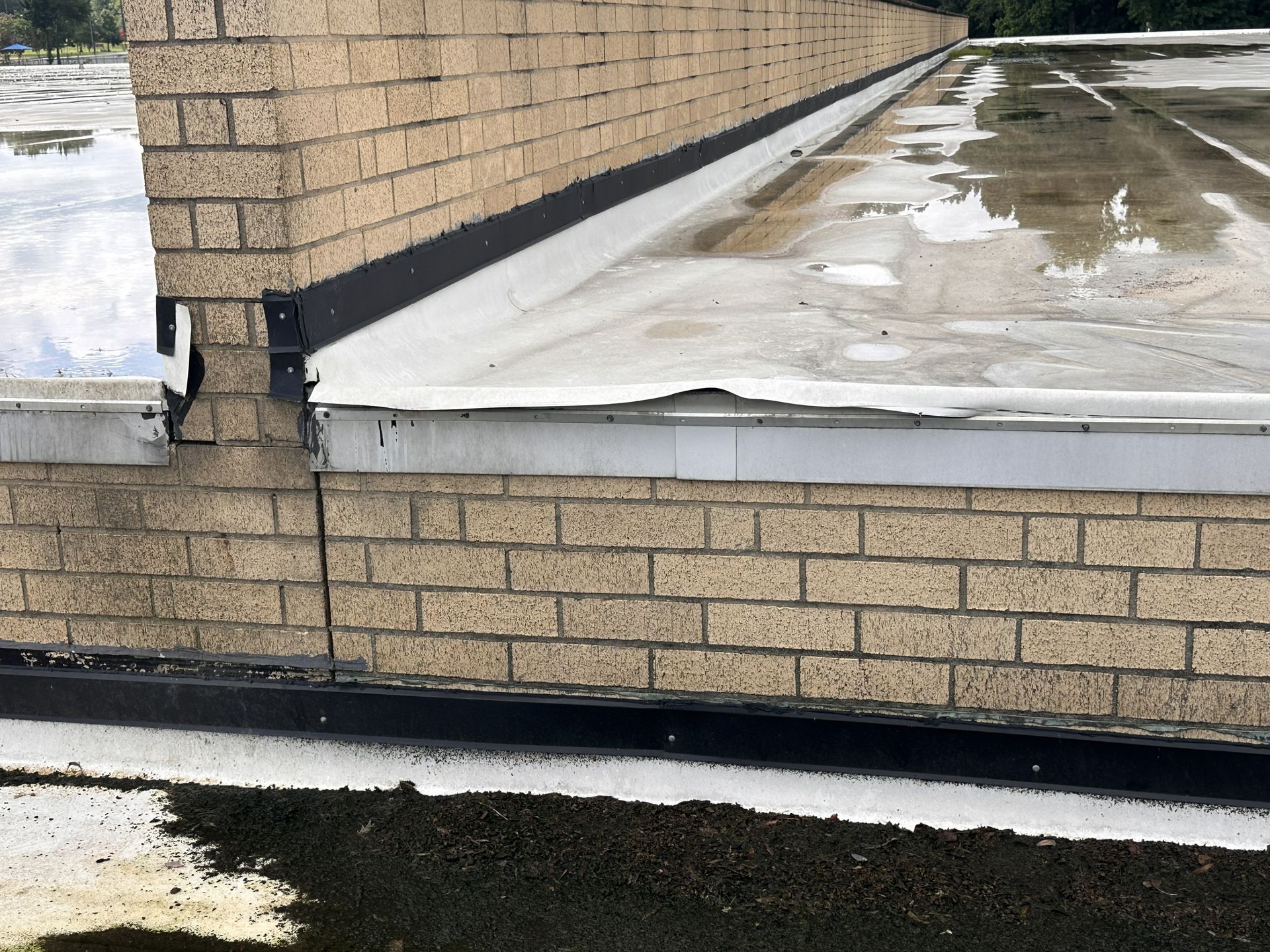
4. Ponding Water or Drainage Problems
Commercial roofs are designed to manage water, not store it.
If water remains on portions of the roof after rainfall, the first question is why.
Clogged drains or scuppers may be responsible. In other cases, the roof may have low areas that prevent water from draining properly.
Even when the roof is dry by the time it's inspected, ponding areas often leave clues behind, including dirt, staining, residue, or debris patterns that show where water has been sitting.
Persistent drainage problems shouldn't be ignored. They can place additional stress on the roofing system and contribute to deterioration over time.
5. Cuts, Punctures, or Other Membrane Damage
Not every commercial roof problem is caused by age or weather.
Sometimes somebody simply damages the roof.
HVAC technicians, electricians, plumbers, sign contractors, and other trades routinely work on commercial rooftops. Tools get dropped. Equipment gets moved. Fasteners get left behind. Materials with sharp edges are dragged across membranes.
A small puncture may be difficult to notice but can still allow moisture into the roof assembly.
That's one reason a roof should be inspected after other contractors have performed significant rooftop work.
6. Water Stains, Dripping, or Other Interior Moisture
A ceiling stain or dripping water is an obvious sign that something needs attention.
What isn't always obvious is where the water came from.
It's natural to look at a stain and assume the leak must be directly above it. Commercial roofing systems don't always behave that way.
Water can enter the roofing system in one location, travel through portions of the roof assembly or along structural components, and finally appear inside the building some distance from the original point of entry.
That means repairing whatever happens to be directly above the ceiling stain may not solve the problem at all.
Finding the actual source requires investigation.
7. The Same Area Keeps Getting Repaired
If the same section of a roof has been repaired repeatedly and continues to leak, it's time to ask a different question:
Are we repairing the actual source of the leak—or just where the water happens to show up?
Repeated repairs can sometimes indicate that the original source was never correctly identified. They can also point
to moisture trapped within the roofing assembly or a larger condition that can't be solved with another surface patch.
At some point, repeatedly applying more repair material becomes more expensive than determining what is actually happening.
The Leak Isn't Always Where You See the Water
This is one of the most misunderstood things about commercial roof leaks.
Water follows available pathways.
Depending on the construction of the roof, water that enters through a membrane defect may travel within the roofing assembly before finally finding a place to enter the building. On buildings with a structural metal roof deck beneath the roofing system, for example, water may travel along the deck flutes and appear inside some distance from the original point of entry.
So when someone places a bucket beneath a ceiling drip and points directly upward, they've identified where the water ended up.
They haven't necessarily identified where the leak began.
Why Is It Still Leaking When It Hasn't Rained?
Here's another situation that can confuse building owners:
It rained several days ago.
The weather is now clear.
And water is still appearing inside the building.
How can the roof still be leaking?
One possible explanation is trapped moisture.
Moisture that entered an existing roofing system may become trapped within insulation or between components of the roof assembly. This can become particularly complicated when a building has more than one existing roofing system.
That moisture doesn't necessarily disappear when the rain stops.
It can continue migrating through the roof assembly and eventually find a pathway into the building, making it appear that the roof is somehow leaking on a sunny day.
This is one reason understanding what's happening beneath the roof membrane can be just as important as examining what's visible on top of it.
There are several reasons a commercial roof may appear to leak even when it hasn't rained.
When trapped moisture is suspected, a commercial roof moisture survey may be necessary to better understand the condition of the roofing assembly.
Finding the Problem Before It Becomes a Bigger Repair
The best time to address a commercial roof problem is usually before water is pouring into the building.
A professional roof evaluation looks beyond the obvious symptom.
At B&D Roofing Solutions, Bill Frey begins by examining the condition of the existing roofing system, paying particular attention to seams, penetrations, HVAC curbs, flashing details, drains, previous repairs, membrane damage, and other areas where problems commonly develop.
With more than 35 years of commercial roofing experience, he also knows that what appears to be the obvious source isn't always the actual source.
When conditions indicate that moisture may be present beneath the membrane, additional evaluation may be appropriate. Depending on the roofing system and circumstances, that can include electronic moisture scanning, carefully selected core samples, or an independent infrared moisture survey.
The objective isn't simply to find somewhere to apply sealant.
It's to understand why the problem is occurring so the appropriate repair can be made.
Does a Roof Leak Mean You Need a New Roof?
No.
A leak means the roof needs attention. It does not automatically mean the entire roofing system needs replacement.
Many commercial roof problems can be repaired when they're identified early enough. Other roofs may be good candidates for restoration once necessary repairs have been completed.
If deterioration is widespread, significant moisture is present throughout the roofing assembly, or the roof has reached a condition where continued repairs no longer provide good long-term value, replacement may ultimately be the better investment.
The condition of the roof—not the existence of a single leak—should drive the decision between roof restoration and replacement.
The B&D Promise
We believe commercial property owners deserve honest recommendations—not sales pressure.
Every roofing system is different, and every building has unique needs. Our job is to evaluate the condition of your roof, explain your options clearly, and recommend the solution that provides the best long-term value.
Whether that's a restoration, a repair, or a complete replacement, we'll explain the reasons behind our recommendation and tell you what we would recommend if it were our own building.